Hellebores might be the perfect perennial. What other plant has lustrous, handsome foliage and sumptuous flowers in an array of shapes and colors? What other plant can tolerate dry as well as wet soils, have few pests and be very deer resistant? These plants are the first to greet the garden center customer in early spring. The cheerful flowers are the perfect complement to spring bulbs with foliage that persists till winter and acts as a foil for annuals and perennials in the summer. Tolerant of severe winters and hot, humid summers, they fill an important niche in the landscape-plant market. They can handle sun as well as shade. In other words, they rock!
Composed of up to 16 species, today's Helleborus hybridus are a glowing example of the work of hybridizers in Europe and England. When Dan Heims traveled through Germany, Belgium, Holland and England with Braunschweig, Germany's top plantsman, Ulrich Fischer, he was exposed to the best breeders and breeding in the world. Enter the O'Byrnes. Ernie and Marietta O'Byrne from Eugene, Oregon have been collecting the best of the best from the same breeders Dan visited. By careful selection over the last several decades, these two breeders have striven to select only the most disease resistant, large-flowered stock plants with pure colors. Large-flowered doubles have been quite elusive, but stock plants were made of the fullest doubles. These stock plants are then carefully pollinated and marked by the specific cross. Every consideration is taken regarding the flower-shape of full, double flowers with evenly-spaced tepals. Plants with finer foliage are selected as the flowers are more easily seen when not blocked by "fat foliage." Even the angle at which the flowers are presented is calculated into the breeding equation. Flowers that hang down (as seen in most old cultivars) are hard to see, those that point too far upward suffer from Botrytis. Each year plants are culled from the stock areas and replaced with only the strongest, best looking plants. This prevents inbreeding which muddies colors and produces weaker, more inferior, less vigorous plants.
Terra Nova was delighted to team up with fellow breeders that had similar ideals of plant perfection. The following double flowering strains are available exclusively through Terra Nova Nurseries:
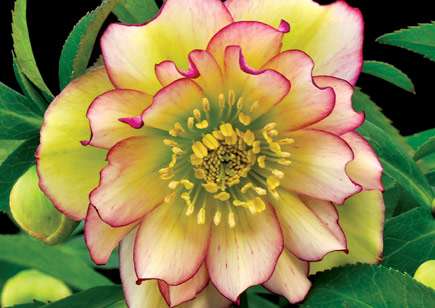 Helleborus Winter Jewels™ Amber Gem |
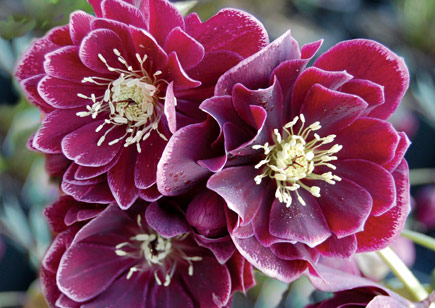 Helleborus Winter Jewels™ Amethyst Gem |
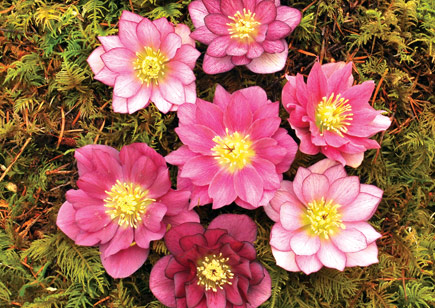 Helleborus Winter Jewels™ Berry Swirl |
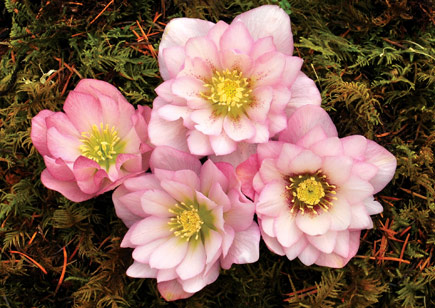 Helleborus Winter Jewels™ Cotton Candy |
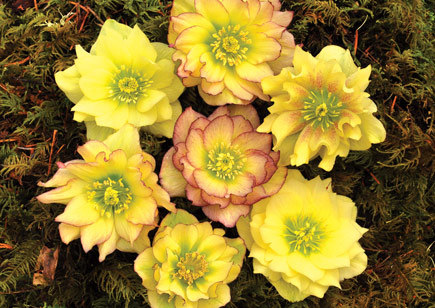 Helleborus Winter Jewels™ Golden Lotus |
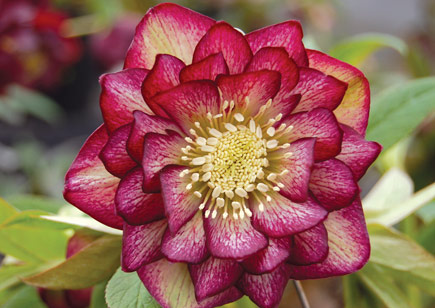 Helleborus Winter Jewels™ Harlequin Gem |
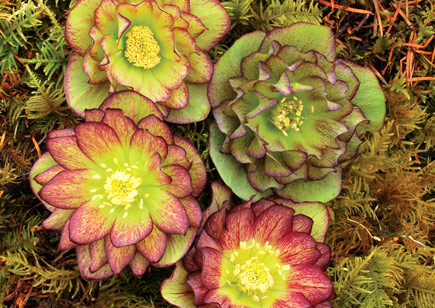 Helleborus Winter Jewels™ Jade Tiger |
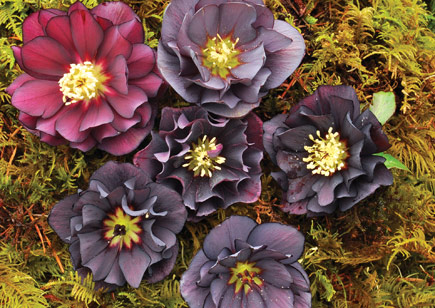 Helleborus Winter Jewels™ Onyx Odyssey |
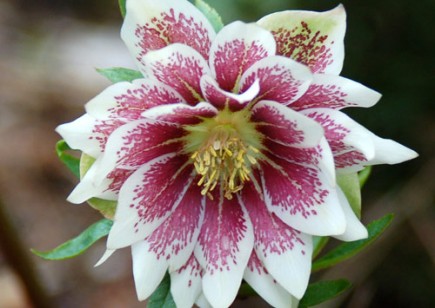 Helleborus Winter Jewels™ Painted Doubles |
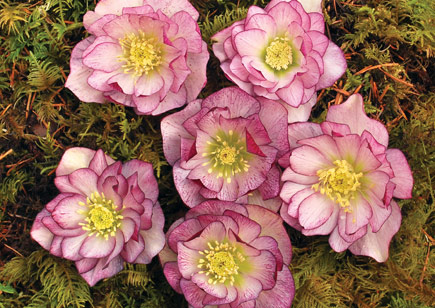 Helleborus Winter Jewels™ Peppermint Ice |
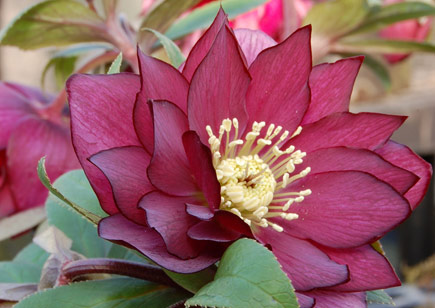 Helleborus Winter Jewels™ Red Sapphire |
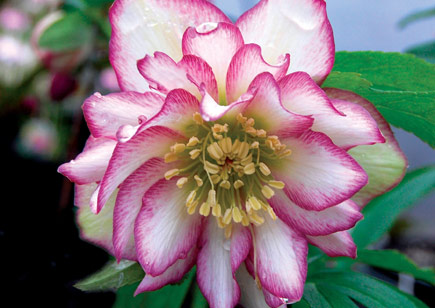 Helleborus Winter Jewels™ Rose Quartz |
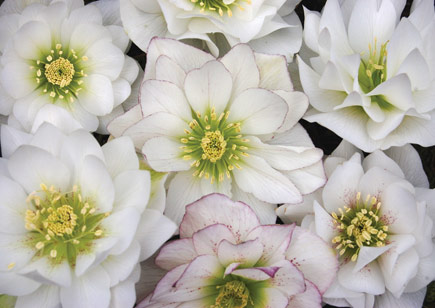 Helleborus Winter Jewels™ Sparkling Diamond |
GROWER TIPS:
Planting
Plant one 30-cell liner per 6-inch or gallon pot with well-drained media. Make sure not to cover the crown by planting too deep. This is the most common failure. The soil level of the pot and liner should match up evenly. A preventative fungicide at potting can be beneficial. A tank mix of mefenoxam and thiophanate-methyl or any other broad-spectrum fungicide will do. Be sure to read the label for desired rates and application intervals. As with any chemical, test on a small group of plants before applying to the entire crop.
Culture
Media: Plant hellebores in a well-drained media with a moderate organic matter content.
pH/EC: Maintain a pH of 5.5 to 6.5 and an EC of 1.0 to 1.5 via the pour-thru method.
Temperature: Hellebores do well with a 40° to 45° F night and a 60° to 65° F day. Much root growth occurs during cooler periods. Plants prefer a cooler location in a greenhouse. Bench temperatures are usually 10+ degrees higher than the ground.
Light: Provide 2,000 to 3,000 foot-candles of light. Use shade cloth between 50% and 70% depending on location during the summer.
PGRs: Configure™ can be beneficial to promote basal branching and can be used when bulking the plant. It can sometimes cause distorted growth on the leaf that was emerging at the time of application, but the plant will quickly grow out of it. It is generally better to use lower rates and apply more frequently as opposed to higher rates with a single application.
Fertilizer/Watering: Supply a low-medium rate of constant liquid feed at 100- to 150-ppm of 20-10-20. Allow the plants to dry slightly between irrigations, but keep plants moist throughout production.
Pests/Disease: Aphids and thrips are the main pests of hellebores. Pythium and Phytophthora can be problems if the plants stay waterlogged for prolonged amounts of time. Fungal leaf spotting can be an issue if the foliage remains wet for prolonged periods of time. Remove the previous year's foliage before, or as, the new growth is emerging. The O'Byrnes recommend a spray sold by Gardens Alive called Pyola Oil that is a mixture of pyrethrins and canola oil that is very effective and is acceptable to organic growers.
Scheduling: Finish time from 30-cell liner to 6-inch pot is 10-12 weeks and from 30-cell to 1 gallon pot is 16-18 weeks. Dormancy is required for flowering.